
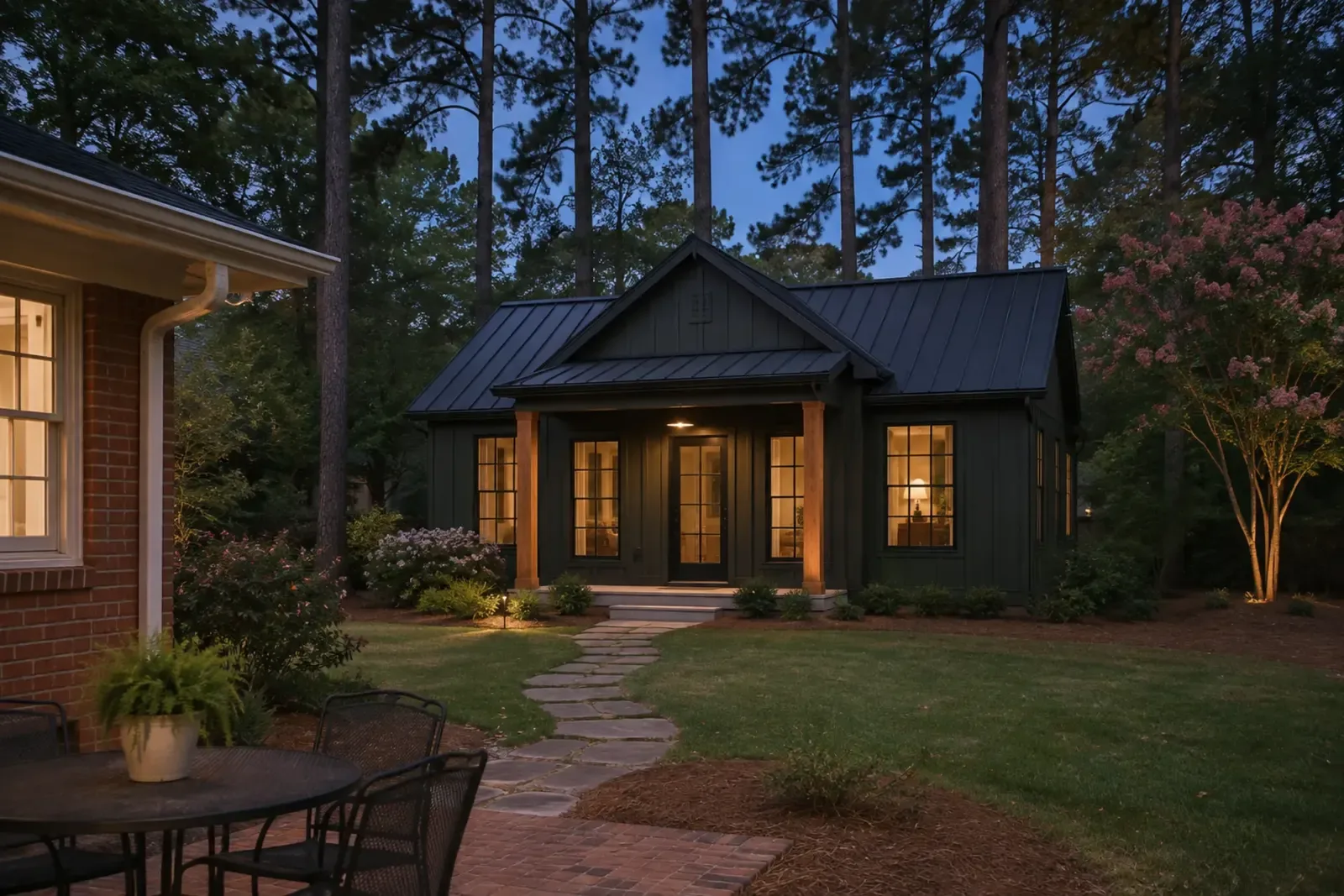
 Illustration, not a real project
Raleigh, NC · Backyard home planning guide
ADUs in Raleigh: rules and permits
An accessory dwelling unit (ADU) is a second, smaller home on a lot with a house. Raleigh has allowed them citywide since July 2020.
Where ADUs are allowed
In the residential zones R-1, R-2, R-4, R-6 and R-10, and in the mixed-use zones RX, OX, NX, CX and DX.
The citywide rule took effect July 22, 2020. Before that, from 2019, an ADU was possible only where a neighborhood chose an ADU overlay.
The main rules
One ADU per lot, or two in a Frequent Transit Area.
It must be smaller than the main house: up to 800 square feet of floor area in most cases, 1,000 on residential lots over 40,000 square feet. Up to 26 feet tall. On a permanent foundation.
It can be detached, attached to the house, or inside it, and it can sit above a garage. It cannot be sold apart from the house.
The city's ADU rules contain no requirement that the owner live on the lot, and the city says no extra parking is needed for an ADU.
Sources and dates
- Raleigh UDO Sec. 2.6.3, Accessory Dwelling
- City of Raleigh, ADU FAQs
- Raleigh UDO Sec. 7.1.2, Required Parking
Last checked 2026-11-25
Two state laws start in January 2027
January 1, 2027: a state law (Session Law 2026-39) stops most North Carolina cities and counties outside the coastal area from requiring a minimum number of parking spaces. Raleigh already removed its parking minimums in 2022.
January 15, 2027: a new state ADU law (Session Law 2026-59, G.S. 160D-917) applies to ADU permit applications filed from that date in cities of 50,000 people or more outside the coastal area. Those cities must allow at least one ADU with each single-family house in residential zones. They may not ban renting the house and the ADU to separate households, require minimum parking, or set a size cap below 800 or above 1,000 square feet. Cities have until July 1, 2027 to adopt matching rules.
The ADU law does not override HOA covenants, and it does not apply in historic districts.
Permits: which route
The route depends on the kind of ADU. A new detached ADU goes through the city's process for a new single-family house. Turning an existing detached garage into an ADU uses the ADU change of use route. An attached addition uses the route for accessory structures and additions.
A plan review fee is due before review. The other permit fees are due when the permits are ready. Confirm your case with the city before you design.
Sources and dates
- City of Raleigh, new single-family dwelling or duplex permits
- City of Raleigh, ADU change of use
- City of Raleigh, accessory structures and additions
Last checked 2026-11-25
Building it yourself
North Carolina requires a licensed general contractor for a job that costs $40,000 or more. An owner who builds on their own land is exempt only for a building meant for the owner and family to live in. The city's ADU FAQ, opened 26 November 2026, says: "If you build the ADU yourself, you cannot rent it." The city also requires a Not For Rent statement before the permit issues. G.S. 87-1(b)(2) is the 12-month own-occupancy test behind that.
Sources and dates
- N.C. G.S. 87-1 (general contractors)
- City of Raleigh, ADU FAQs (updated 14 Jul 2026; opened in browser 26 Nov 2026)
Last checked 2026-11-26
Where this guide covers
Planning a backyard home in Raleigh?
Ask about your lot. Send your address and we send back one page with your lot's rules. Your request goes to Tiny Home Raleigh only, not to a builder.